
Branch County VINE Coverage
Michigan VINE is a custody-information and notification service. It receives records from participating agencies and presents the status that each source sends. The national portal says most counties take part, but not every county or custodian supplies all data. Research did not confirm Branch County Jail coverage through a lawful live person result. The safe reading is conditional: use VINE when the Michigan search returns the person and clearly names the Branch source, then verify the result with that source.
This distinction matters in Coldwater. Branch County Jail is run by the Sheriff and holds local pretrial detainees and jail-sentence prisoners. Lakeland Correctional Facility is an MDOC state prison. A state prisoner may appear in both VINE and the state corrections systems, while a jail-only person is expressly outside OTIS. VINE does not turn these separate custody systems into one certified file.
Search Branch County VINE Records
Start at the official VINELink portal and search only one person at a time. A common name can return several people, and a matching name alone is not enough. Use an identifying number when one is known. Otherwise compare the name, source agency, facility, identification field, and any other lawful detail that the result shows.
- Select Michigan before entering the person’s information.
- Choose the offender or custody search presented by the live interface.
- Enter the name or identifying number, then narrow the source or facility when that option appears.
- Open the likely record and match the identifying details rather than relying on the name alone.
- Read Custody Status, the status date, identification number, location, and reporting agency together.
- If the result says released, contact the reporting custodian when the precise release event matters.
The portal interface can change, but the evidence test remains the same. A result is useful only when the person and reporting source match. For a broad named-person trail that also uses court and records-request channels, the Branch County released inmate search explains which custodian to check first.
Search terms can also affect the outcome. OTIS searches a person’s current legal name, while a VINE source may follow its own name and identifier rules. Try a known identification number before broadening the name search. When several matches remain, do not guess from age or name alone. Compare every displayed identifier and the reporting facility. A false match can attach the wrong custody event to the wrong person. If the live record supplies too little detail to resolve the match, contact the named source with the identifying information already known.
Note: Record the date and time of the check because a VINE status may change after the contributing agency sends a later update.
Read Branch County VINE Results
VINELink is not a certified release record. Its main value is a quick view of the status reported by a participating source. The exact words and fields depend on the agency. Released or out-of-custody language is also system-relative. A person can leave Sheriff custody through community release, transfer to MDOC, transfer to another jail, or transfer to a federal agency.
| Field | How to read it |
|---|---|
| Custody Status | The current label supplied by the reporting source, not a certified release reason. |
| Status Date | The date linked to that reported status. It may not be the precise jail-door time. |
| Reporting Agency | The jail, prison, or other source whose custody is described. |
| Location | The facility or source location shown when the agency provides it. |
| Offender ID | An identifying number that helps separate people with similar names. |
| Notification Option | The available route to register for a later custody event or status change. |
A release status from Branch County Jail does not by itself mean release to the community. Ask whether the person was released, transferred, or picked up on another hold. For a court-backed explanation, read the Branch 3-A District Court case and follow any felony bind-over to 15th Circuit Court through MiCOURT Case Search.
Branch County VINE Screen
The live VINELink search is the source for Michigan custody-status and notification options. Select Michigan again if the portal opens without a state context.
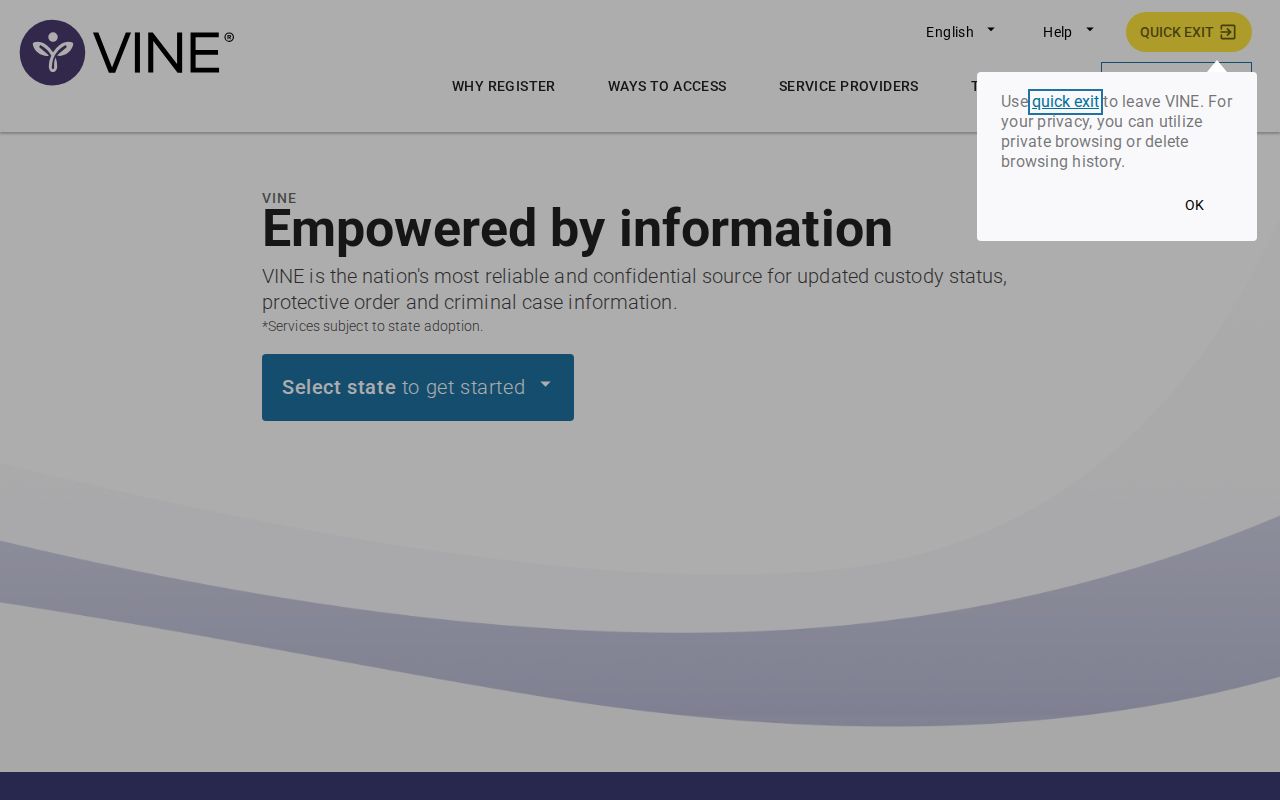
The captured interface shows where a user begins. It does not prove that Branch County Jail supplied a particular person’s record or that any past status remains current.
Register Branch County Release Alerts
Registration must be tied to the correct person’s record. Search first, match the source, and then choose the notification control that the live record offers. Delivery methods can include telephone, text, email, or an in-app notice, but the actual mix depends on the source and state setup. Register before an expected custody event rather than waiting for the anticipated day.
- Open the matched person record and select the notification or “Get Notified” option.
- Choose an offered delivery channel and enter the destination carefully.
- Continue to the security step and create the required four-digit PIN.
- Enter the PIN again as requested. It confirms receipt for voice alerts and helps manage the registration.
- Complete any email or text confirmation and save the registration details.
- Keep a second confirmation path with the jail, MDOC, or court rather than relying on one alert.
VINE Help covers registration and notification questions when the live controls differ from an older screenshot. Contact information must remain current. A missed call, filtered email, changed number, network issue, or source delay can keep an alert from arriving at the expected time.
Note: A VINE notice is an alert from reported data, while a custodian-produced release sheet is the stronger document for exact confirmation.
Branch County Conditional Reporting
Branch County has no official public jail roster, recent-release archive, or confirmed sheriff app. That makes conditional VINE language especially important. The official Branch County Corrections page supplies the jail contact route, but it does not publish a searchable table. VINE can add a status clue only when its result names a participating source for the person.
If the search returns nothing, check spelling, identifiers, state selection, and facility. Then call the Branch County Jail at 517-278-2325 and ask the narrow question: is the person currently held, released from Branch custody, or transferred? If a record is needed, use the Sheriff-specific FOIA form to request the nonexempt booking and release or transfer fields. This local chain is stronger than treating a blank portal as an answer.
A court docket supplies another check. Bond, dismissal, sentencing, and transfer orders can explain why custody changed, though a docket may not state the exact physical exit time. Read the order and custodian record together.
The status date deserves the same care. It may identify the effective event date, a source update, or another point defined by the reporting agency. Do not silently turn it into an exact release time. If timing is important, ask the Sheriff for the release or transfer date and time recorded in the jail system. When staff cannot disclose it by telephone, make a focused records request and accept nonexempt portions with lawful redactions.
Branch County Custody Systems
The reporting agency determines which system can answer the question. A county jail status, a state prison parole, and a federal release are different events. Use the matching official route.
| Custody path | Primary check | What it can establish |
|---|---|---|
| Branch County Jail | Jail contact, Sheriff record, court | Local hold, release, transfer, and legal authority. |
| Lakeland or another MDOC prison | OTIS and MDOC records | Prison, parole, probation, or recent discharge status. |
| Federal criminal custody | BOP locator or federal docket | BOP release information or the federal case trail. |
| Immigration custody | ICE detainee locator | ICE custody information when the person and record are eligible to appear. |
The MDOC OTIS landing page expressly excludes county-jail-only prisoners. It includes current prisoners, parolees, probationers, and people within the public post-discharge window. The BOP Inmate Locator is separate and covers federal prisoners released from 1982 forward. VINELink should not be presented as a substitute for either source.
Confirm Branch County VINE Releases
A status becomes more useful when paired with a source record. For a Branch jail event, ask for the release or transfer date, release reason or code, releasing authority, booking number, court number, and receiving agency when releasable. Michigan FOIA applies to existing nonexempt records and does not require staff to create a new analysis. The public body generally gives an initial response under MCL 15.235, which is not a promise that all records will be produced within that first period.
For state custody, read the overall OTIS status before reading dates. `PAROLE` means prison release into continuing MDOC supervision. `DISCHRG` means MDOC jurisdiction ended for that sentence. Date Paroled records a completed transition, while Earliest Release Date is an eligibility field, not an appointment. For exact state documents, an identified MDOC FOIA request can seek the available discharge certificate, parole order, time-computation record, or photo.
Older state records need another route. OTIS normally keeps people visible for three years after the latest discharge from supervision. A person outside that window may still have records at the sentencing court or MDOC. MDOC identifies separate contacts for current prisoner records and certain past-prisoner files. The public search window is therefore a display rule, not proof that an older event never occurred or that all underlying records were destroyed.
Immediate safety decisions should never depend on VINE alone. Maintain direct contact with the responsible agency and use the official record tied to that custodian. A saved alert confirmation helps troubleshoot the registration, but it does not certify where the person went after leaving one facility. Recheck the reporting source after any expected transfer.