
Branch County Release Date Meanings
A projected date is an estimate or eligibility point based on the record that a particular agency maintains. It is not the same as the actual time a person walks out of a facility. Michigan OTIS does not label one universal field “Projected Release Date.” For an active state prisoner, it can display Earliest Release Date and Maximum Discharge Date. Once parole occurs, Date Paroled records the completed prison-to-supervision transition.
The first field marks when the Parole Board can have jurisdiction under the sentence and credit framework. Eligibility does not mean approval. The maximum field is a potential outside date, subject to lawful sentence structure and corrections. Date Paroled is retrospective. A Branch County Jail release calculation is separate and does not appear in OTIS for a jail-only person.
Find Branch County Projected Dates
Begin with the facility. A person at Lakeland Correctional Facility or another MDOC prison follows the state route. A person held only at Branch County Jail follows the Sheriff and court route. Federal and immigration custody use their own systems. This first choice prevents a state eligibility date from being applied to a county jail sentence.
- Confirm whether the person is in Branch County Jail, an MDOC prison, federal custody, or another agency’s care.
- For MDOC custody, open the official OTIS landing page and launch the search application.
- Use the six-digit MDOC number when known. Otherwise search the current legal name and add filters.
- Match the person by date of birth and other identifiers before reading sentence fields.
- Read overall status and location first, then compare Earliest Release Date, Maximum Discharge Date, and Date Paroled.
- For Branch County Jail, obtain the signed judgment, jail credit, calculation, and any recorded hold from the jail and court.
- Return to the custodian after the expected event to confirm the actual release or transfer.
For a jail-only case, call Branch County Jail at 517-278-2325. Ask for the recorded calculation rather than asking staff to predict from the sentence length. The MiCOURT Case Search can show the order behind custody. Adult criminal matters start in 3-A District Court, while a qualifying felony moves to 15th Circuit Court after bind-over.
A complete named-person path is also available through the Branch County released inmate lookup. It explains how a court order, jail record, and state or federal status fit together when a transfer is possible.
Note: A court order supplies legal authority, but processing and checks for other holds can occur before the physical exit.
Branch County OTIS Date Fields
OTIS includes current MDOC prisoners, parolees, probationers, and people discharged within the previous three years. It excludes county-jail-only prisoners. A no-result screen may mean the person was never in MDOC, is outside the public window, was searched under a different current legal name, or is excluded for another reason.
| OTIS field | Meaning |
|---|---|
| Earliest Release Date | The first parole-eligibility point under the applicable minimum and credit rules, not promised release. |
| Maximum Discharge Date | The potential outside end of MDOC jurisdiction, subject to sentence and record corrections. |
| Date Paroled | The date the person obtained parolee status and left secure MDOC custody. |
| Status | Whether the record currently shows prison, parole, probation, discharge, or another MDOC state. |
| Location | The institution or supervising office associated with the current MDOC status. |
`PAROLE` means the person has left prison but remains under supervision. `DISCHRG` is the stronger signal that MDOC jurisdiction ended for that sentence. A probationer’s earliest-release column can instead describe a Supervision Release Date. Always interpret the date in light of the status line.
Branch County Release Date Screen
The live OTIS application is the matching manifest source for state prisoner searches and result fields.
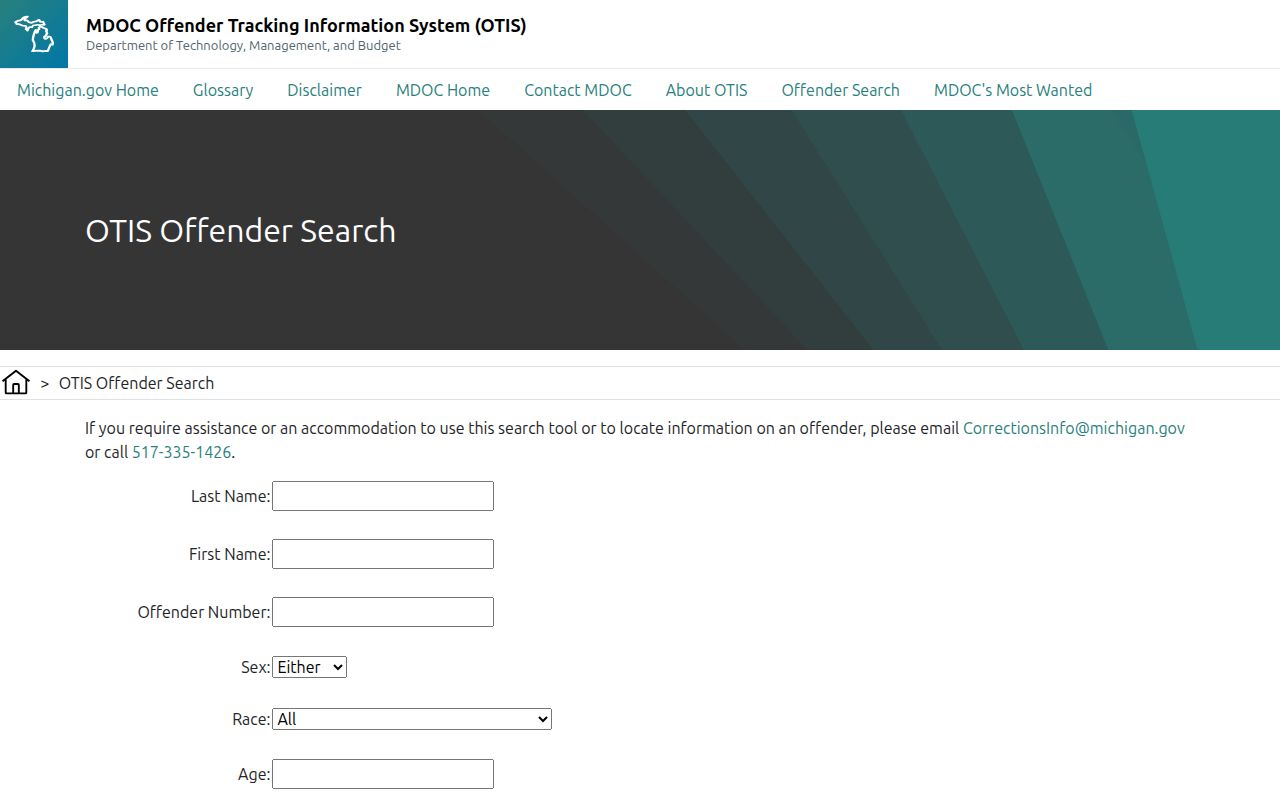
The screen starts the MDOC lookup. Once a result is opened, the status and exact date labels must be read together rather than reduced to one projected date.
Branch County Has Two Credit Systems
Branch County users encounter two distinct sentence-credit rules. This is the distinctive local issue identified in the research. Coldwater contains both the county jail and Lakeland Correctional Facility, but the same calculation cannot be used for both. Michigan truth in sentencing governs covered state sentences. County jail good time comes from a separate county statute and approved jail rules.
Michigan does not have a general rule that every state prisoner serves 85 percent. The MDOC truth-in-sentencing explanation says covered prisoners serve 100 percent of the judicial minimum before parole consideration. The framework covers specified assaultive crimes committed on or after December 15, 1998, and other crimes committed on or after December 15, 2000. The offense date and judgment are essential.
For an eligible Branch County Jail prisoner without violations, MCL 51.282 allows one day of reduction for each six days of sentence. Sheriff rules approved by circuit judges govern forfeiture and restoration. Jail credit, concurrent or consecutive terms, conduct, and any other valid hold still affect the actual calculation. An OTIS Earliest Release Date therefore cannot calculate a Sheriff release.
Note: Obtain the recorded computation from the responsible agency because neither a flat percentage nor a public homegrown calculator can account for all inputs.
Michigan State Release Calculations
For covered disciplinary-time sentences, MCL 791.234 generally places Parole Board jurisdiction after service of the court minimum. Older or otherwise credit-eligible sentences may use lawful good-time or disciplinary-credit rules. Offense date determines which framework can apply. Consecutive sentence minimums and maximums combine as the law directs.
Disciplinary time is not a simple number that a reader should add to or subtract from the public field. MDOC considers Class I misconduct information in its process. A Time Review and Disposition can reflect jurisdiction, minimum, maximum, and disciplinary-time information. For a precise calculation, request the current record instead of rebuilding it from fragments.
- Parole eligibility
- The point when the Board may consider release. It is not an order to release.
- Parole
- Release from prison into continuing MDOC supervision under stated conditions.
- Discharge
- The end of MDOC jurisdiction for the sentence shown.
- Detainer
- A notice that another authority may seek custody, which can change where the person goes.
Board review can consider the offense, institutional conduct, programming, history, age, guideline scores, validated risk information, and other lawful material. Even a positive decision can require placement review and release coordination before Date Paroled appears.
Why Branch County Dates Change
A valid date can move because the record or legal basis changes. A screenshot proves what the system displayed at one moment. It does not freeze the sentence, court orders, or placement process.
| Factor | Possible effect | Best confirmation |
|---|---|---|
| Amended judgment | Changes a minimum, maximum, or sentencing term. | Signed court order and corrected agency record. |
| Jail-credit correction | Moves the calculated service point. | Court judgment and current time computation. |
| Consecutive sentences | Adds terms under the governing structure. | Sentence entries and agency calculation. |
| Conduct or legacy credits | Changes eligible older state or county calculations. | Current MDOC or jail computation. |
| Parole decision | Authorizes, denies, or continues review but may not set the physical exit alone. | Notice of Decision and later status. |
| Detainer or new order | Can block community release or send the person to another custodian. | Custodian record and court or agency notice. |
| Data correction | Updates a field that was entered or calculated incorrectly. | Live official record and correction office. |
OTIS content drawn from court records may require correction at the sentencing court. A supervision or absconder issue belongs with the listed MDOC office. Technical errors use the MDOC webmaster route. The source of the problem determines where the correction starts.
Branch County Pretrial Release Timing
A pretrial detainee does not have a sentence-based projected release date. Bond may authorize release, but jail staff must process the event and check for other warrants, detainers, or agency holds. A dismissal in one case does not resolve another hold. A court docket may explain the authority without recording the precise jail-door time.
The official Branch County bond page describes cash-only, cash-or-surety, ten-percent, and personal-recognizance routes. Posting bond does not show acquittal or final disposition. It permits release pending the case when all applicable terms and holds are resolved. Ask the jail whether the person remains held, was released to the community, or was transferred.
For documentary proof, the Sheriff-specific FOIA route can seek the nonexempt release or transfer date and time, reason or code, releasing authority, booking and court number, and receiving agency when releasable. A signed court order and jail release sheet make a stronger pair than a projected date inferred from the docket.
The official Branch County Corrections page publishes no regular release hour, exit door, weekend sequence, or property-return schedule. The jail operates continuously, but that fact does not create a promised processing time. Call for the particular person and date. A family plan should allow for a later exit, a transfer, or a hold that the original case docket does not resolve.
Confirm Branch County Release Dates
Before the expected event, check the live official status and keep the access date. Afterward, confirm which agency released the person and where the person went. A parole from Lakeland ends prison confinement but starts community supervision. A transfer from Branch County Jail to MDOC ends Sheriff custody but is not community release. A federal or ICE transfer needs the receiving agency’s records.
A Branch County VINE inmate check can provide a redundant status alert when the reporting source participates. It should not be the sole plan. For exact proof, use the jail record, Date Paroled and OTIS status, an MDOC discharge certificate, or the matching federal record.
Older state matters may disappear from public OTIS three years after discharge. The sentencing court, MDOC past-prisoner record route, or Michigan State Police ICHAT may then be appropriate. Absence from the current public search does not erase the event, and it does not prove release on a particular day.
Keep the access date with every saved result. If two official records disagree, ask the office that owns the disputed field to review it. Court conviction or sentence errors begin with the sentencing court, while supervision and location issues belong with MDOC. A fresh source record is stronger than an older screenshot.