
Lakeland Release Statuses
Lakeland Correctional Facility is an MDOC Level II men's prison. It houses sentenced state prisoners, not local pretrial detainees. A person leaving Lakeland may transfer to another MDOC institution, move into parole supervision, or reach discharge under the sentence. A transfer only changes the prison location. Parole means physical prison release with MDOC supervision still active. Discharge means MDOC jurisdiction over that sentence has ended. These events should never be collapsed into the single word “released.”
OTIS attaches the state custodian to the status. `PRISON` with a new location points to a transfer. `PAROLE` and a Date Paroled show the transition out of prison into community supervision. `DISCHRG` is the later end-of-supervision state. Probation can also appear in OTIS, but it is court-ordered community supervision and does not prove that the person left Lakeland on the probation date.
| OTIS information | Meaning for Lakeland |
|---|---|
| PRISON and facility | Still in MDOC prison custody at the displayed location |
| New prison location | Transfer within MDOC, not community release |
| PAROLE and Date Paroled | Left prison and remains under MDOC supervision |
| DISCHRG | MDOC supervision ended for the sentence shown |
Search Lakeland Releases in OTIS
The official MDOC OTIS page is the correct public route for a Lakeland prisoner, parolee, probationer, or recent discharge. Search by the unique six-digit MDOC number when it is known. Otherwise, use last name and first name with the available filters. A last name can be searched with the first three letters followed by an asterisk. Match date of birth and other identifiers before reading the status because names alone are not enough.
- Open the official OTIS landing page and review its coverage before launching the search.
- Enter the MDOC number, or search by name and narrow the result with available filters.
- Open the matching record and read overall status and current location first.
- Review Earliest Release Date, Maximum Discharge Date, Date Paroled, and discharge details as separate fields.
- Record the access date, since a transfer or release can change the live result.
OTIS covers current prisoners, parolees, probationers, and people discharged within the prior three years. It does not cover a person confined only in Branch County Jail. After the three-year public window, use the sentencing court, a focused MDOC records request, or the Michigan State Police ICHAT route when appropriate. A missing result is not proof that no state custody existed.
Lakeland Release Record Fields
An OTIS result can show the MDOC number, commitment name, date of birth, physical descriptors, photograph when available, status, location or supervising office, sentence entries, offense, county of conviction, minimum and maximum terms, Earliest Release Date, Maximum Discharge Date, Date Paroled, and discharge information. Exact fields depend on the person's sentence and stage. Read the overall status before interpreting one date from a sentence row.
Michigan uses exact labels for distinct points. Earliest Release Date marks the first date the Parole Board may have jurisdiction under the applicable minimum and credit rules. Maximum Discharge Date is the potential outside date. Date Paroled records an actual transition to parole status. Eligibility does not equal approval, and even a positive parole decision can require placement and release coordination.
- Parole
- Release from prison into continued MDOC supervision under stated conditions.
- Discharge
- The end of MDOC jurisdiction for the sentence shown.
- Maximum discharge
- The potential outside sentence date, subject to lawful computation and sentence structure.
- Transfer
- Movement between MDOC facilities while prison custody continues.
Request Lakeland Release Proof
A live OTIS result is useful, but a custodian-produced record is stronger when exact proof matters. Send a focused request through MDOC FOIA. Identify the person by name and MDOC number and specify the record sought. Useful records may include the discharge certificate, Basic Information Sheet, parole order or Notice of Decision, dates and reason, a time-computation sheet, and an available electronic photograph. Do not request a complete file when only the release event is needed.
MDOC's FAQ explains that a PENPACK may contain certified documents such as a judgment, photograph, fingerprints, parole material, and discharge certificate, but the complete package is limited to recognized criminal-justice authorities for official business. A public requester should ask for specifically identified nonexempt records. Access and redaction rules vary by document. The discharge certificate is stronger evidence of sentence discharge than a search screenshot, while Date Paroled proves prison exit into supervision rather than sentence completion.
MDOC FOIA CoordinatorP.O. Box 30003
Lansing, MI 48909
Email: MDOC-FOIA@michigan.gov
Phone: 517-335-4194
Fax: 517-335-4193
Lakeland Release Date Limits
Michigan truth in sentencing is not an 85 percent rule. For covered offenses, the prisoner serves 100 percent of the judicial minimum before parole consideration. Offense date matters because older sentences can follow legacy good-time or disciplinary-credit rules. Consecutive minimums and maximums can add under the governing sentence structure. No public percentage calculator can account for the judgment, jail credit, offense date, consecutive terms, disciplinary history, court changes, and later holds.
The Parole Board is the sole paroling authority for MDOC felony prisoners. It may consider the offense, institutional conduct, programming, parole guidelines, validated risk information, interview material, and other lawful factors. A favorable decision still is not the same as physical release. Placement review, a new detainer, amended judgment, data correction, or later Board action can change the course. The parole eligibility statute provides the legal framework, but an individual date must come from MDOC's own calculation.
Note: A dated screenshot preserves what OTIS showed at that moment, not a permanent promise about a future Lakeland release.
Lakeland Records and Contact
The official Lakeland facility page identifies the institution, location, security level, and main contact. The public email is useful for facility questions, but release certification and offender records belong with the responsible MDOC unit. A family inquiry should not ask facility staff to estimate a release date from sentence length.
Lakeland Correctional Facility (LCF)141 First Street
Coldwater, MI 49036
Phone: 517-278-6942
Email: mdoc-lakeland-public@michigan.gov
For supervision after parole, OTIS usually displays the supervising location. Branch County's MDOC Parole/Probation office is at 31 Division Street in Coldwater and can address local supervision or correction questions. It is not the Branch County Jail release desk and it does not replace the Parole Board or MDOC records office.
Official Lakeland Facility Source
The MDOC Lakeland page is the source for the institution's current identity and contact information.
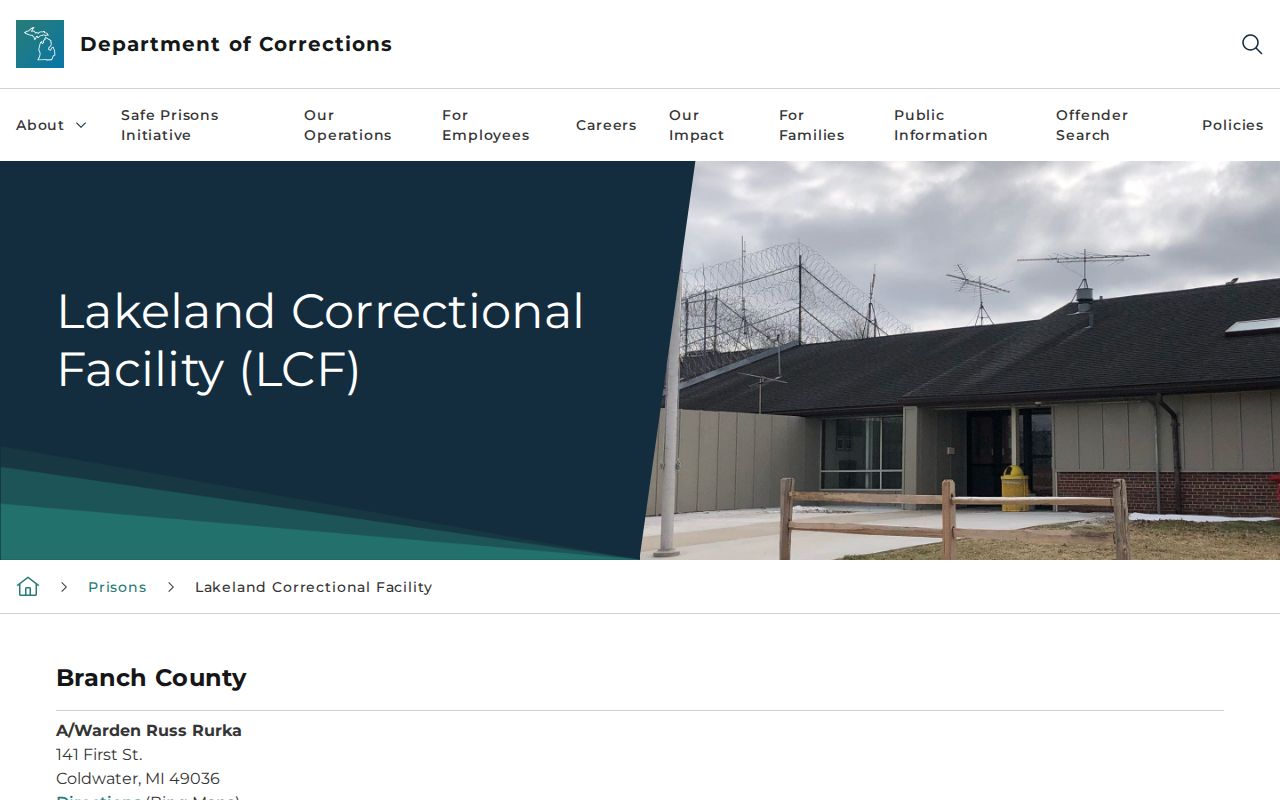
The captured page helps distinguish Lakeland from the nearby county jail, but it does not replace OTIS for a person's live status or release trail.
Lakeland and Coldwater Prison History
MDOC says Lakeland opened in 1985 and uses mainly dormitory units, including geriatric accommodations. It remains an active Level II men's institution. Nearby Florence Crane Correctional Facility closed in 2011, and former Camp Branch appears only in historical state material. An old record may name one of those sites, but neither closed location should be presented as a current facility or current-release path.
Coldwater's county jail and state prison make the custody fork unusually important. A person booked only at Branch County Jail will not appear in OTIS. A person sentenced to Lakeland should not be searched through a county roster. Start with the agency on the record. The Branch County release search overview explains how jail, court, state, and federal records fit together when the custodian is uncertain.
After a Lakeland Parole
A parolee has left prison but remains under MDOC. Conditions and the parole term come from the individual order. OTIS may show the supervising office and Date Paroled. The local Field Operations office can address supervision matters, while the Parole Board handles Board authority and MDOC records staff handle documents. Discharge comes later if the sentence and supervision end successfully or another lawful end event occurs.
A person can also leave Lakeland for another custodian. A federal or immigration detainer may result in transfer rather than community release. Attach the system to each statement: “paroled from Lakeland,” “transferred within MDOC,” or “discharged from MDOC.” That precise phrasing prevents a prison release from being mistaken for the end of every legal obligation.
Routine parole interviews do not appear on a comprehensive public calendar. MDOC's public hearing notices concern limited lifer, pardon, and commutation matters, and a hearing notice only proves that a hearing was scheduled. A grant still requires release processing. For an actual Lakeland transition, Date Paroled and `PAROLE` provide the stronger public status evidence, followed later by `DISCHRG` if supervision ends.